
Entrepreneurial mindset: Taking responsibility


Entrepreneurial progress depends on ideas being turned into value for others, and this often requires someone to connect an opportunity with a shared sense of purpose1 to ensure buy-in from others.
A strong vision helps because it gives others a north star that can act as an orientation when things get busy, and messy. When direction is clear, uncertainty becomes easier to navigate, decisions gain a reference point, and collaboration has something concrete to gather around2.
Ideas stall not because they are bad, but often because no one makes them easy enough to follow. Turning one’s own thoughts into collective action is a challenge, and it rarely happens on its own. Taking responsibility over the process is making a possible future real enough that other people can see it, believe in it, and want to help build it.
Being instructive on how to follow, embracing followers as equals and not making about the leader or the person who’s responsible, are important aspects. Similarly, aligning interests and reframing the vision to suit the different perspectives of those involved is an important skill. Willingness to act and to drive a concept forward is the hallmark of an entrepreneurial spirit, whilst resilience and persistence are similarly connected to being entrepreneurial.
Entrepreneurs don’t ask for permission, they just get on with it
John Mullins, Associate Professor of Management Practice in Marketing and Entrepreneurship at London Business School
Make the future easy to visualise
Before anyone can commit to a direction, they must be able to picture it and understand it. That sounds simple, but it is where many promising ideas lose momentum. A vision that lives only inside the leader’s head cannot be questioned, improved, or shared.
A recent systematic review defines vision communication as articulating images of a collective future, showing that it works through motivational, cognitive, and emotional mechanisms2. In other words, people need more than just understanding the destination, they need to feel connected to it. That connection only forms when the person who owns the vision has translated an internal picture into something externally valuable and desirable.
That process benefits from disciplined reflection. Some questions worth answering are:
- What does the future look like if this works?
- Why does it matter now, and not later?
- Which parts of the vision are fixed, and which should be shaped with others along the way?
These are not rhetorical questions. They push a us to test whether the vision actually holds up. Direction gets stronger when it can withstand scrutiny, and more compelling when it improves through discussions, disagreements and integration.
Key point
A vision becomes useful the moment other people can picture, question, and refine it. That only happens if you have made it visible and allow some degree of friction.
Build commitment by meeting people where they are
Making the future visible is one thing. Getting people to invest in it is another. Commitment is almost never built through a single persuasive moment; as mentioned in previous lines, it develops when individuals understand how a direction connects to what already matters to them.
Research on stakeholder engagement emphasises inclusive structures and attention to a broader range of people in value creation3. In practical terms, that means the same opportunity often needs to be explained differently to different people: A colleague wants to know whether it is feasible; A partner weighs timing and risk; A student responds to relevance and real-world impact. Each person has a different doorway into the vision.
Taking responsibility therefore involves translation. The core opportunity stays consistent, while the framing adjusts to the audience. Some useful questions to guide that process:/p>
- Who needs to be engaged early, and why?
- How does each person’s own work or values connect to this direction?
- Where is hesitation most likely to come from, and how can those concerns be addressed honestly?
Commitment deepens when people can see their place in the effort and when they believe their contribution will influence the outcome. Agreement alone is not enough. People need to feel that they are genuinely shaping something, not just being recruited to carry it out.
Key point
People engage through their own doorway. Taking responsibility means owning the process, and adjusting how the opportunity is explained, not what the opportunity is.
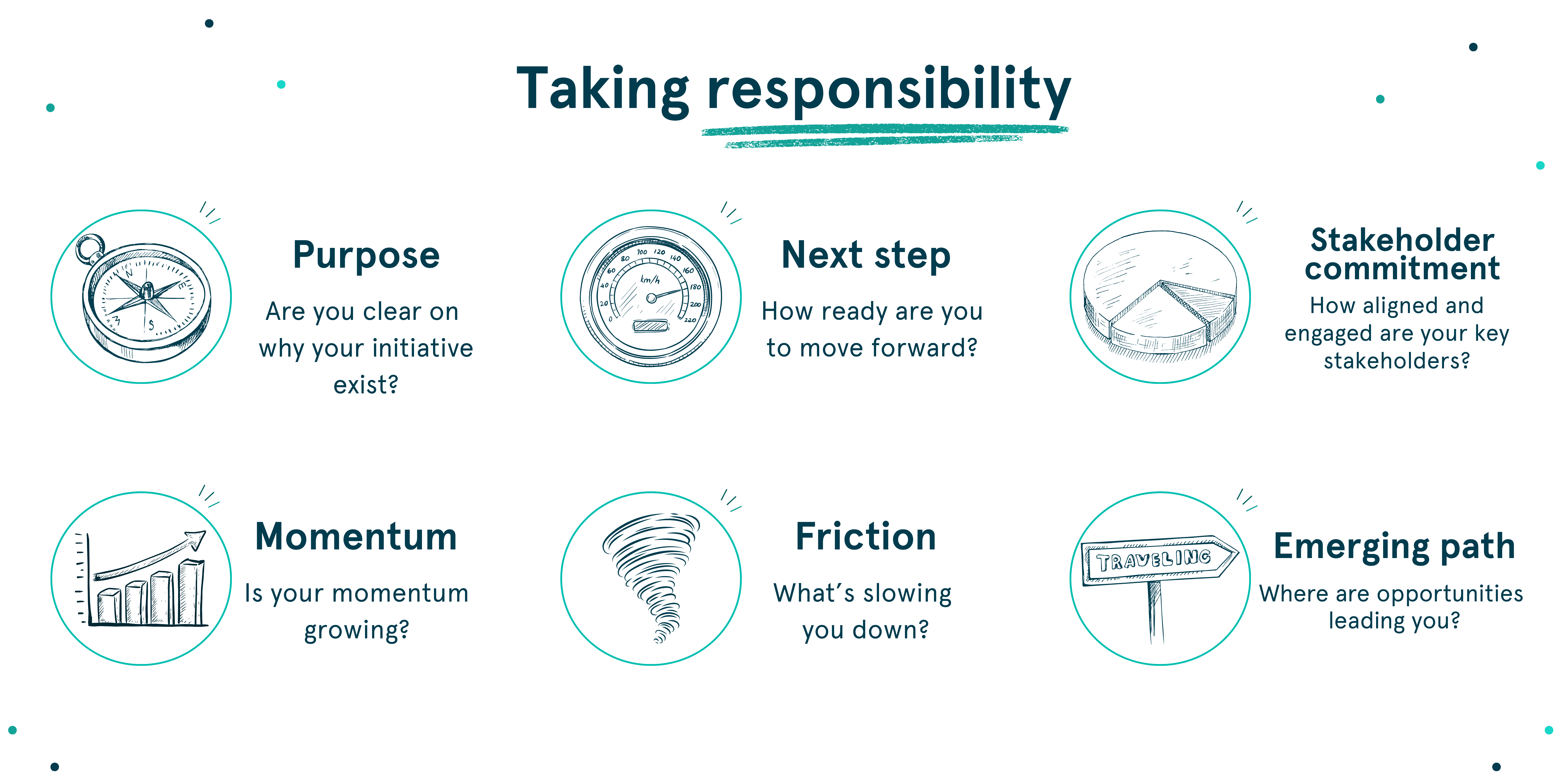
Shape what comes next
One of the more freeing ideas in entrepreneurial thinking is that a leader does not need to see the whole path before inviting others to walk it.
Pilot in the plane
Saras Sarasvathy’s work on effectuation draws a useful distinction: causal logic starts from a fixed goal and works backward to find the means, while effectual logic starts from what is already available and focuses on what can be shaped now4. The most recent edition of Effectual Entrepreneurship develops this further, describing effectuation as co-creating valuable futures with people who want to take part5.
Applied to taking responsibility, this reframes the job considerably. The question is not “Have we planned this thoroughly enough?” but “What can we do now that opens the next door?” That might mean holding a first conversation, bringing in a key partner, running a small pilot, or setting a milestone concrete enough for others to rally around. None of these require certainty, but all of them create forward motion.
This is where taking responsibility and signalling become genuinely entrepreneurial. Momentum builds when people can see the direction emerging through their own participation, not being handed down from above.
Clear the path for the people around you
Even when direction is clear and commitment is real, execution can quietly lose speed. Unclear responsibilities, slow approvals, duplicated effort, and unspoken assumptions are all usual suspects. Leadership at this stage is less about inspiration and more about removing the friction that stops capable people from moving.
Research on entrepreneurial leadership highlights several consistent patterns: articulating an opportunity-seeking vision, experimenting proactively, encouraging innovation, and orchestrating resources through influence rather than control6. What stands out in that list is how much of it can be facilitated. A leader clears the path, ensures decisions have owners, keeps communication flowing, and brings the right people and resources together at the right moment.
There is also a credibility dimension here. Teams pay close attention to whether difficult problems are being acknowledged and handled, or being quietly ignored. Consistent, follow-through from the leadership builds trust in the direction itself. People are more willing to push forward when they can see that obstacles are being dealt with rather than ignored and accumulated.
Key point
Inspiration sets the direction. Taking responsibility and actively removing obstacles and friction is what keeps people moving toward it.
Create the right conditions for others to be responsible and lead
Longer-term progress becomes more robust when leadership and responsibility are genuinely shared rather than tightly held. Shared leadership is a dynamic process where authority naturally shifts toward the person whose knowledge and skills are most relevant at any given moment7. Strong leadership does not end with one person setting the tone, it is empowered when others are trusted to take initiative, contribute their expertise, and own part of the journey.
This has real cultural implications. Through delegation, mentoring, and the signals someone who takes responsibility sends on a day-to-day basis, teams learn whether challenge is welcome, whether responsibility is real, and whether people are expected to think beyond their formal role, and leadership flows naturally. Over time, those signals become the culture.
Make problems visible
The Toyota Production System gives frontline workers a clear way to act when they notice that something is wrong. Through the andon system, an operator can signal a problem immediately, prompting a team leader to come to the workstation and help address it. The aim is to make problems visible early, before defects or ineffective practices continue through the production process. Toyota introduced andon boards and lights as part of jidoka, an approach often described as automation with a human touch9.
Key point
Responsibility grows when people have permission, practical mechanisms, and leadership support to raise concerns. Speaking up becomes part of the work itself.
Stay steady when it gets hard
Progress doesn’t tend to happen smoothly, and obstacles are often a challenge for those who take responsibility. However, the initiatives most worth pursuing and leading are usually the ones that meet the most resistance. Resilience is not optional; it is part of the leading role itself.
When setbacks arrive, teams look for cues. Does the person driving the initiative still believe in this? Is learning being taken seriously? Can things change without everything falling apart? The answers to those questions are communicated less through words, and more through behaviour (e.g., calm judgement, continuity of the approaches, and the willingness to interpret difficulty as learning rather than failure).
Some obstacles call for persistence. Others call for revision. Part of taking responsibility is helping people understand which response the situation actually demands, so that adjustment does not feel like retreat, and momentum does not quietly drain away before anyone names what is happening.
Key point
Resilience is not about pushing through regardless of anything or anyone. It is about protecting purpose while being honest about what needs to change.
Conclusion
Taking responsibility of the process is how an individual idea becomes coordinated movement. It begins with making the future understandable, develops through honest engagement with the people whose support matters, and gains traction when the leader creates the conditions for shared ownership, clear execution, and genuine adaptability.
None of this requires a complete picture from the start. The pilot in the plane principle offers the more useful frame: begin with what can be shaped now, make the next commitment visible, and bring others along as co-creators rather than followers4 5. Over time, that approach builds something more durable than a well-articulated plan. It builds a team that knows how to move together through uncertainty, through setbacks, and toward something worth building.
References
- Bacigalupo, M., Kampylis, P., Punie, Y., & Van den Brande, G. (2016). EntreComp: The Entrepreneurship Competence Framework. Publications Office of the European Union.
- Zhao, Q., & Lian, H. (2025). Vision communication: A systematic review. Journal of Management.
- Aaltonen, K., Derakhshan, R., Di Maddaloni, F., & Turner, R. (2024). Stakeholder engagement: Theoretical and methodological directions for project scholarship. International Journal of Project Management, 42(7), 102649.
- Bonini, A., Panari, C., Caricati, L., & Mariani, M. G. (2024). The relationship between leadership and adaptive performance: A systematic review and meta-analysis. PLOS ONE, 19(10), e0304720.
- Sarasvathy, S., & Wheatley, G. B. (2025). Effectual Entrepreneurship (3rd ed.). Routledge.
- Sarasvathy, S. D. (2001). Causation and effectuation: Toward a theoretical shift from economic inevitability to entrepreneurial contingency. Academy of Management Review, 26(2), 243–263.
- Hoang, G., Luu, T. T., & Babalola, M. T. (2025). Entrepreneurial leadership: A systematic literature review and research agenda. Leadership & Organization Development Journal, 46(2), 285–313.
- Wietrak, E., & Gifford, J. (2024). Trust and psychological safety: An evidence review. Chartered Institute of Personnel and Development.
- Toyota Motor Corporation. (2012). Development and deployment of the Toyota Production System. In 75 Years of Toyota.
- Wassenaar, C. L., Pearce, C. L., & Lorinkova, N. (2025). Shared Leadership 2.0: Taking Stock and Looking Forward. Cambridge University Press.
Jose Villagran-Polo (author) is the Deputy Manager R&D Projects at UIIN and works on topics related to university-business collaboration, entrepreneurial education and the role of university-based incubators in their regions.
Luca Barbera (author) is a Project Officer at UIIN. His work encompasses a broad spectrum of research topics, including sustainability, deep tech, engagement practices for universities and academics, with a particular emphasis on the valorisation of results


