What if we rebuilt the university? Ideas and experiments from the UIIN Summit

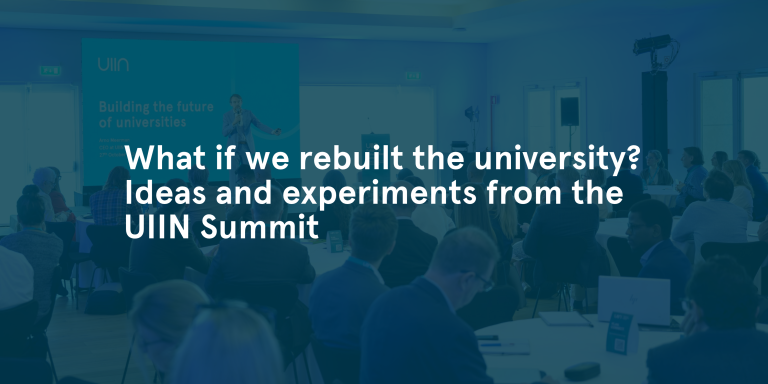
What would a university look like if students could return throughout their lives, local communities helped govern it, and its doors remained open long after the working day ended?
These were among the ideas explored at the UIIN Future of Universities Summit, held in Lisbon on 28–29 October 2026. Participants imagined institutions built around curiosity, community ownership and lifelong learning. One group created a university called Hotel California, where learning never really ends. Another proposed a University of Humanism, placing human connection and purpose at the centre of education.
The ideas were deliberately provocative. Yet the discussions soon returned to a practical question: What would need to change in today’s universities to make these futures possible?
Across two days of keynotes, institutional case studies and interactive workshops, university leaders and practitioners examined how established structures, academic incentives, funding models and relationships with society shape what universities can achieve.
What would you change if you could start again?
Participants questioned familiar assumptions about university life.
Andrew Petter, President Emeritus of Simon Fraser University, argued that universities need to pay greater attention to how they demonstrate their value to society. While new ideas and discoveries flourish within them, universities can be remarkably resistant to changing their own ways of working.
The challenge became tangible during the Breaking the University workshop. Could university facilities open to local communities around the clock? Would rotating academic leaders between faculties build understanding across disciplines? Participants also considered funding arrangements that allow longer-term planning and closer working relationships between academic and administrative teams.
Some proposals were intentionally radical. Others identified changes that could be tested within existing institutions.
The following day’s Building the University workshop explored possible futures shaped by technological change, inequality, local community needs and the changing nature of learning. These exercises highlighted how university structures reflect choices made in the past. Many still serve a purpose; others deserve reconsideration. The challenge is turning that reflection into action.
Making innovation part of university life
How can universities move from individual initiatives to changes that become part of the institution?
Three partners in Accelerate Future HEI addressed this question through their own experiences. The four-year European project, coordinated by UIIN, has supported nine universities in developing their entrepreneurial and innovation capabilities. The three institutions presented different approaches, reflecting their ambitions, resources and regional environments.
At Politehnica University of Timișoara (UPT) in Romania, the challenge was to make entrepreneurship support more continuous. Building on its established InnoHub initiative, the university brought together student ambassadors, prototyping facilities, startup competitions and entrepreneurial activities embedded within courses. This created more regular opportunities for students to develop ideas, experiment and connect with mentors. Accelerate also helped strengthen the university’s approach to understanding and measuring the results of these activities.
At the University of Applied Sciences St. Pölten in Austria, the starting point was an established Seven Steps to Startup Support model. The model supported technology-oriented ventures, but did not fully reflect the institution’s ambitions for wider societal impact. Through Accelerate, the university began adapting it to include social innovation and societal challenges. This involved communities in identifying problems, encouraged collaboration across disciplines and recognised that valuable ideas can create impact without resulting in a commercial startup.
For Vidzeme University of Applied Sciences in Latvia, transformation has focused on connecting university activities more closely with regional development. Working with municipalities and regional partners, Vidzeme used Accelerate to develop and refine business laboratories over three cycles. Each iteration offered opportunities to test approaches, strengthen staff capabilities and build relationships across the regional innovation ecosystem. The experience also helped the university move towards a broader student innovation programme connected to the regional Open Innovation Hub.
These developments also revealed a shared challenge: sustaining activities when resources are limited and external funding is uncertain. At UPT, annual funding arrangements and reliance on a small group of committed staff make long-term planning difficult. At Vidzeme, the lack of dedicated structural funding for regional innovation remains an obstacle.
Together, these cases show how transformation grows from existing strengths, provided institutions can secure the people, resources and ownership to carry the work forward.
Another Summit case showed what building an innovation system looks like in especially difficult circumstances. YEP Accelerator and Kyiv Aviation Institute in Ukraine described how years of entrepreneurship education and startup support are feeding into a university-wide innovation pilot, despite the pressures of war. The work includes a new chief innovation officer role and testing pathways for academic spin-offs. Their experience showed how institutions can build entrepreneurial capacity even while facing extraordinary uncertainty.
Changing what academic careers reward
Universities increasingly encourage collaboration, knowledge exchange and societal engagement. Academic careers, however, are still often assessed through criteria that give greater weight to traditional research outputs.
At Oregon State University, this prompted a review of promotion and tenure policies. Jana Bouwma-Gearhart described how the institution worked through faculty governance to broaden recognition of academic contributions, including intellectual property, research translation and engagement beyond academia. One unexpected challenge was the language used to describe these activities.
An initial emphasis on innovation and entrepreneurship raised concerns among academics who did not identify with commercialisation. The broader concept of research translation helped connect the initiative to different disciplines and forms of contribution.
The experience also demonstrated the time required for institutional change. Revising central policies involved extensive consultation, while implementation across individual colleges remains an ongoing process.
Participants in the Summit’s leadership discussions recognised similar challenges. They emphasised that institutional strategies need to be reflected in academic workloads, assessment criteria and the resources available to staff. To contribute to ambitious goals for societal engagement, academics need to see how these activities relate to their work and careers.
Letting students explore problems without predetermined answers
Manuel Dolderer, co-founder of CODE University of Applied Sciences, and Ed Fidoe, co-founder of the London Interdisciplinary School, explored what happens when students take greater responsibility for deciding what they investigate.
At CODE in Berlin, project-based learning allows students to explore challenges they find meaningful. Supported by academic mentors, they develop ideas, build prototypes and learn through experimentation. Dolderer reported that CODE students had founded more than 100 startups. He also emphasised the importance of students developing confidence in their ability to create solutions.
The approach has required academics to rethink their roles. Supporting independent learning involves judging when students need guidance and when they will learn more by working through uncertainty.
The London Interdisciplinary School has taken another route, designing programmes around complex problems that require students to draw on different disciplines. Both models challenge universities to consider how learning should prepare graduates for problems and careers that cannot yet be predicted. This demands changes to curricula, teaching and assessment, and to the relationship between students and academic staff.
St. Pölten’s experience offers a related lesson for established institutions: broader opportunities for students to work on societal challenges can begin with adapting programmes and support structures that already exist.
Rethinking the university’s relationship with its region
What responsibilities should universities take for the places around them, and who should decide what matters?
The University of Oxford’s Equinox initiative offered an example of a university reconsidering its role within a regional innovation ecosystem. Murray Gardner explained that Oxford’s research and commercialisation activities had contributed substantially to the region, while engagement with local partners had not always been coordinated around shared priorities.
The university recognised that challenges involving infrastructure, investment, housing and unequal economic opportunities required a more collective approach. Equinox was developed to bring businesses, public authorities and other regional organisations together around a common vision, with the university supporting coordination while seeking to avoid dominating the initiative.
At Alvernia University in Pennsylvania, Cammie Harris, Rodney Ridley and Caitlin Long presented a hands-on model through the O’Pake Institute for Economic Development and Entrepreneurship. Its student-powered SPARK Business Incubator connects students with local businesses and entrepreneurs on practical projects, from marketing to business planning. Students gain experience while local organisations access support. The case showed how economic development, learning and community engagement can become part of the same everyday activity.
Shared ownership also emerged as a theme during the Designing Partnerships for Impact workshop. Participants explored how to structure partnerships around shared purpose, reciprocity and meaningful contributions from different stakeholders.
They highlighted that relationships often begin with relatively small collaborations. Trust and mutual understanding develop over time, creating opportunities for more ambitious cooperation. Universities therefore need to recognise the value of relationship building and allow external partners to influence priorities.
Regional engagement takes different forms depending on institutional context. The needs of Oxford’s internationally recognised innovation ecosystem differ considerably from those of Vidzeme’s predominantly rural region. The underlying question is similar: how can universities make their knowledge, facilities and networks useful to the people and organisations around them?
Measuring impact beyond traditional university performance
As universities reconsider their contribution to society, they also need to examine how they measure success. Research publications, patents, spinouts and external income remain important indicators, but capture only part of the value universities create.
During the Summit’s Measuring What Matters discussion, the Fourth Generation University approach considered how universities could be assessed through their role within regional innovation ecosystems. Eindhoven University of Technology illustrated this through its exploration of indicators such as graduate retention, industry collaboration and the integration of regional engagement into university strategy.
The discussion emphasised local context. Universities need to consider which outcomes matter in their regions and who benefits from their activities.
The Accelerate case studies also illustrated how measurement shapes institutional practice. At UPT, more systematic reporting helped strengthen the credibility of innovation activities and provide evidence of their contribution. At Vidzeme, presenters highlighted how extensive administrative and reporting requirements can take time away from experimentation and engagement.
These experiences suggest that measurement should help universities learn and make decisions, while remaining proportionate to the work involved. Understanding whether an initiative has delivered meaningful change also requires looking beyond immediate outputs. Partners and communities can help identify outcomes that conventional performance indicators may overlook.
What should universities take home from Lisbon?
The Summit brought ambitious visions of future universities into conversation with institutions already experimenting with change. Ideas about lifelong learning and community governance sat alongside the practical work of reforming academic assessment, adapting entrepreneurship programmes and building regional partnerships.
Institutional transformation takes different forms in different settings. It depends on each university’s context, the people involved and what the institution values and supports.
Across the discussions, participants returned to established practices that deserve scrutiny: rules that discourage experimentation, funding arrangements that interrupt promising initiatives, and assessment systems that make engagement difficult.
The workshops closed by challenging participants to identify something they could question or change when they returned to their institutions. That invitation extends beyond those who attended.
If you could redesign one aspect of your university today, what would you change, and what is stopping you from starting?
Ready for more?
How can universities turn ambitious visions of transformation into lasting institutional change? In our whitepaper, How to build more engaged, entrepreneurial and innovative universities: Four levers to cultural change, we explore practical ways to embed entrepreneurship, innovation, and external engagement into university culture through greater awareness, effective communication, aligned incentives, and accessible support.
Rimante Rusaite (author) is the R&D Projects Lead at UIIN and holds an MSc in Environmental Policy and BSc in Psychology. Dedicated to sustainability and innovations. She’s also a design thinking coach and systems thinking enthusiast.