How universities build entrepreneurial ecosystems: Lessons from the University of Bristol

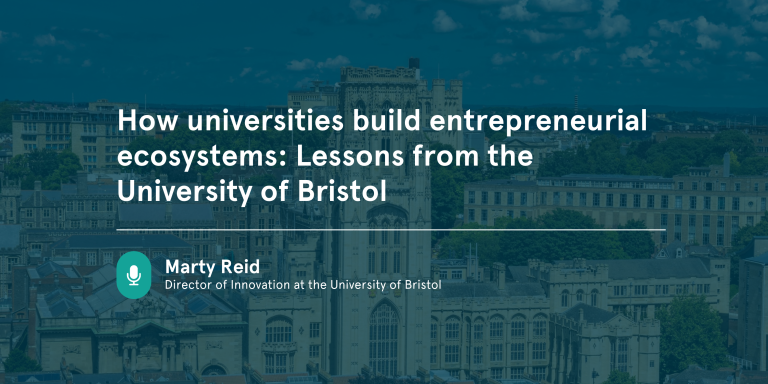
How can a university strengthen an entrepreneurial ecosystem without trying to control it?
In this episode, Marty Reid, Director of Innovation at the University of Bristol, dives into how Bristol’s role has evolved as its regional ecosystem has matured, and shares his perspective on building an ecosystem that can support globally ambitious companies and create lasting regional value.
You can listen to the conversation on our podcast or read the summary below:
Also available on:


Summary
Universities hold many of the resources that entrepreneurial ecosystems need: research, specialist facilities, intellectual property, technical expertise, and a continual flow of talent. Yet those assets create regional value only when founders, investors, industry partners, public bodies, and communities can reach and use them. For Marty Reid, Director of Innovation at the University of Bristol, the university’s contribution therefore depends on how well it connects people and capabilities across the wider ecosystem.
Bristol’s experience shows how that role changes as an ecosystem matures. The university helped establish regional support infrastructure while developing its own pipeline of spin-outs and research-led ventures. It now operates alongside an expanding network of incubators, accelerators, universities, investors, and professional services. Its task is increasingly to concentrate on the areas where its research base, facilities, convening power, and long-term perspective add distinctive value, while helping the wider region remain connected, accessible, and ambitious.
An anchor institution creates routes into the ecosystem
Reid describes the University of Bristol as an anchor institution with the capacity to convene different parts of the entrepreneurial ecosystem. It produces technical and commercial talent, generates intellectual property and know-how, attracts research funding, and operates facilities that young companies could rarely access independently. These capabilities support venture creation directly, but they also give the university a broader role in shaping the conditions around new businesses.
We really act as an anchor institution for the entrepreneurial ecosystem, with the potential to convene a lot of the component parts and other communities that make it up.
That role developed early through organisations located beyond the traditional campus. The University of Bristol was a founding member of the SETsquared Partnership, which brought a commercial and founder-oriented approach to supporting regional start-ups alongside the university’s internal ventures. It also established Engine Shed with Bristol City Council as a neutral enterprise hub near the city’s central railway station. The centre supported university programmes while giving other incubators and accelerators space to develop.
This outward-facing approach placed the university inside the ecosystem rather than at its edge. As Bristol’s support infrastructure has grown, the university has been able to focus more sharply on research-led spin-outs, deep technology, creative technology, and specialist facilities. It has also extended entrepreneurship and skills activity through micro-campuses in parts of East and South Bristol that have had fewer connections to the city’s technology sector.
Complementary strengths allow regional collaboration to scale
The Bristol and Bath ecosystem is connected through sectors and relationships rather than a single institutional structure. Health technology, aerospace, energy, and other clusters draw on capabilities across the University of Bristol, the University of Bath, and the University of the West of England. Companies, mentors, and entrepreneurs move between these institutions, while each university brings a different research profile, entrepreneurial culture, location, and set of facilities.
This complementarity makes collaboration practical. Bristol contributes research scale and a growing spin-out pipeline. The University of the West of England offers major innovation facilities and broad skills programmes close to an advanced manufacturing cluster. Bath brings strengths in areas such as energy systems, climate, and management. Reid argues that regional partners can compete when appropriate because they understand where their capabilities differ and where joint action will strengthen the cluster nationally.
What helps us collaborate as well as compete is probably the trust that’s been built up in the ecosystem over a long time.
That trust has grown through repeated, informal contact. Incubators, business support organisations, regional government teams, inward investment specialists, and technology clusters meet to discuss common problems from an entrepreneur’s perspective. The relationships make it easier to refer companies to the right support and to recognise when another organisation is better placed to help.
Trust works best with light coordination
Connections give entrepreneurs a clearer route through a complex ecosystem, but Reid cautions against turning those relationships into excessive governance. Mapping organisations and capabilities can improve navigation. Problems arise when information sharing and alignment begin to consume the time that partners should spend working with founders and companies.
Entrepreneurial ecosystems are messy and creative. They have to be.
Some overlap and competition are healthy because they allow new approaches to emerge. An overly coordinated system can also become difficult for new organisations to enter, particularly where established partners already know one another well. Even an open network may appear closed from the outside. Maintaining space for new participants and ideas is therefore part of the ecosystem’s resilience.
Universities can support this balance by hosting relationships without attempting to own them. They can introduce entrepreneurs to professional advisers, investors, researchers, and public bodies, while accepting that each participant has different incentives. Reid points to professional services as one example. Lawyers, accountants, and banks may offer affordable support because it develops staff and builds a future client pipeline. Incubators can make that relationship useful by preparing credible, ethical companies, and entrepreneurs gain advice they could not otherwise afford. The partnership works when each side understands what the others need.
Physical proximity strengthens early stage relationships
Digital delivery has widened access to programmes, but Reid sees physical proximity as especially valuable during a company’s formative years. Early development is uncertain and stressful. Founders benefit from being able to meet peers, advisers, investors, and university specialists without having to build every relationship from a distance. Proximity also gives companies practical access to laboratories, equipment, and research teams.
Place and proximity is incredibly important to the formative stages of companies.
The University of Bristol has embedded this belief in its Temple Quarter Enterprise Campus beside Bristol Temple Meads station. The campus brings incubation and acceleration activity, industry partnership teams, research groups, the business school, and advanced capabilities in areas including artificial intelligence, cybersecurity, and supercomputing into one location. Start-ups, scale-ups, and industry research and development teams can work alongside researchers and students, while the station provides direct connections to investors and corporate partners elsewhere in the country.
The aim is to create a permeable meeting place rather than an isolated university facility. Success would include more research-led companies being created, scaled, and retained in the region, stronger investment in deep technology, and earlier industry participation in venture development. It would also be visible in what grows around the campus: new businesses, facilities, partnerships, and links between the university and neighbouring communities.
Regional value depends on talent markets and inclusion
Global ambition and regional retention can reinforce one another when companies continue to find value in their original ecosystem. Reid argues that founders are more likely to retain a presence, return after an exit or failure, or support the next generation when their early experience is open, collaborative, and useful. The region must then keep pace with companies as their needs change.
For scaling ventures, this means looking beyond the founding team. Companies need help finding employees as they grow, including the people required between their first hires and later expansion. They need investors with enough specialist knowledge and capital to support science and technology businesses over longer development cycles. They also need credible routes into global markets, which universities can help create by convening corporate partners around emerging technologies and programmes.
The benefits of that growth must also reach people who are currently distant from the technology sector. Reid sees access to training and employment as essential to the legitimacy of university-led innovation, particularly when public money helps build the research base and supporting infrastructure.
I wake up at night thinking: What if we’re accidentally creating an even more imbalanced society through the work we’re doing?
The question changes how ecosystem success should be assessed. Venture capital, spin-out numbers, and company growth remain important, but they do not show who can participate or benefit. A stronger measure would examine whether local and regional residents can develop the skills to work in growing companies, including in roles that do not require specialist scientific training. It would also ask whether regeneration around Temple Quarter connects neighbouring communities with the university and the opportunities created there.
Marty Reid’s account presents the entrepreneurial university as a long-term partner in a living regional system. Its contribution grows when it connects distinctive capabilities, supports trusted relationships, and creates accessible places where collaboration can develop, while keeping the wider distribution of opportunity in view.
Ready for more?
How are other universities strengthening their regional entrepreneurial ecosystems? In our podcast episode How universities shape entrepreneurial ecosystems: Lessons from Manchester Metropolitan University, Jennie Shorley and Rob McKay explore how trust, complementary institutional strengths, and accessible support help businesses navigate Greater Manchester’s innovation landscape.
For a broader perspective, our whitepaper Reimagining engagement: A new framework for university engagement examines four models of university engagement and how institutions can align their strategies, partnerships, and regional responsibilities to create greater societal impact.
Stay tuned for the next episode on this series and don’t forget to follow us on your preferred podcast platform!