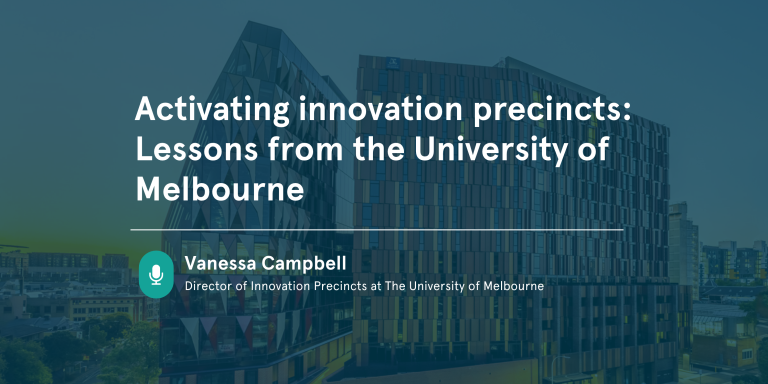
Activating innovation precincts: Lessons from the University of Melbourne

What turns a shared innovation space into a working ecosystem?
In this episode, Vanessa Campbell, Director of Innovation Precincts at the University of Melbourne, explains why an innovation precinct needs more than organisations sharing the same address. Drawing on Melbourne Connect and the university’s wider precinct portfolio, she shows how shared challenges can develop into pilot projects, consortia, and faster routes to collaborators, talent, capital, and customers.
You can listen to the conversation on our podcast or read the summary below:
Also available on:


Summary
Universities can assemble impressive innovation precincts around research facilities, companies, hospitals, cultural organisations, and government partners. The presence of those organisations creates potential, but proximity does not automatically produce collaboration. Vanessa Campbell, Director of Innovation Precincts at the University of Melbourne, argues that precincts generate value when people deliberately build the relationships, programmes, and pathways that allow partners to work together.
The University of Melbourne operates across precincts with different histories, ownership structures, and areas of focus. The Melbourne Biomedical Precinct has developed over roughly 150 years, Melbourne Connect was intentionally designed as a co-location and networking hub, and the Melbourne Arts Precinct connects university cultural assets with a wider creative environment. Their differences make a single model impractical. Each precinct needs a clear purpose, a relevant cluster of partners, and sustained work to convert shared location into outcomes that individual organisations could not achieve alone.
Precinct strategy begins with purpose and context
Innovation precincts can emerge gradually or be planned from the outset. The Melbourne Biomedical Precinct grew from an early decision to place the university close to a clinical hub. Hospitals, medical research institutes, and sustained government interest then accumulated around that foundation. Melbourne Connect represents a more deliberate approach. It was designed to co-locate the university with companies and build an innovation ecosystem through its physical structure, operating arrangements, and partnership model.
These different origins shape what the university can do. Its role within an established biomedical network differs from its role in an environment developed with a commercial partner. Governance, ownership, institutional influence, and the maturity of existing relationships all affect how a precinct can be activated. Vanessa therefore approaches each location as its own network rather than applying the same operating model everywhere.
You’re seeking a collaborative environment in which you’re part of a network of entities.
This perspective also sets a useful boundary around university leadership. A university may convene partners, invest in infrastructure, and provide specialist capability, while accepting that collaboration requires shared influence. Precinct development depends on working within a network rather than seeking full control over it.
Co-location requires repeated and purposeful interaction
A building filled with relevant organisations may still function as a collection of separate tenants. Vanessa distinguishes deep one-to-one partnerships from the wider one-to-many relationships that make an ecosystem useful. The first establishes what the university and a particular company want to achieve together. The second creates conditions in which partners can find customers, capital, ideas, collaborators, and talent across the network.
It doesn’t work just to happily sit each other stacked in a building. You’ve got to put a program in place.
The programme needs several forms of interaction because partners engage in different ways. Informal breakfasts and morning teas can help people become familiar with one another. Communities of practice support regular exchange around a shared field. Curated workshops allow selected participants to examine a specific opportunity, while larger events can introduce a challenge to a broad audience. Melbourne Connect combines these approaches through a programme of around 300 events each year.
Frequency alone is insufficient. Precinct teams need to understand the challenges and opportunities facing their partners, invite them into relevant activities, and introduce them to the people who can help. Repeated contact gives relationships time to develop and creates clearer routes from a first meeting to a serious collaborative proposal.
Critical mass creates routes to consortium building
A productive cluster needs enough relevant capability to move from networking into collective action. Depending on the field, that mix may include companies, researchers, clinicians, government agencies, philanthropic organisations, and community representatives. The cluster can begin without every possible partner, provided the initial group is large and connected enough to attract others and start credible work.
If you’ve already got a critical mass, you’ve got half the players in the room. You can genuinely get going with one of those challenges.
The University of Melbourne has used this logic through both large events and partner-led problems. An event on disinformation brought together around 400 people, then moved interested participants through workshops and a theory-of-change process. That progression produced pilot projects and work towards a consortium focused on a healthy information environment. The event created visibility, while the managed follow-up converted interest into activity.
A separate initiative began with Jacobs Australia identifying PFAS pollution as a challenge for industry clients. The university connected that problem with artificial intelligence and quantum capabilities associated with Melbourne Connect. This created opportunities around the identification, remediation, and replacement of PFAS. The value came from combining an external problem with clusters that could approach it from different directions.
Consortia offer an important sign that a precinct is functioning. They show that relationships have developed beyond bilateral university partnerships and can address complex challenges through several forms of expertise. Interfaces between clusters can be especially productive because they connect capabilities that may not normally encounter the same problem.
Partnership brokers provide the operating infrastructure
The work that activates a precinct is often less visible than its architecture, brand, or events. Vanessa identifies dedicated partnership brokers as essential infrastructure. They learn what organisations need, make informed introductions, and help promising collaborations progress. Their knowledge prevents every participant from starting each relationship from the beginning.
Partnership brokering is the magic that often gets missed from innovation districts.
Warm introductions matter because partners arrive with different pressures. A company may need customers, specialist talent, investment, or a faster route to research expertise. A researcher may need an industry context or access to a practical problem. A broker who understands both sides can connect them with greater precision and prepare them for a useful first discussion.
The role continues after the introduction. Collaborative ideas often need support as participants clarify their objectives, navigate institutional processes, and decide whether they are prepared to co-invest. Trust develops over time, so these roles require consistent resourcing. Treating brokerage as an optional addition leaves a gap between a busy programme and the deeper partnerships a precinct was created to support.
Partner selection and outcomes protect the precinct purpose
Activation begins before an organisation moves into a precinct. Melbourne Connect uses referral networks, selection criteria, due diligence, a charter, and direct discussions about what an applicant wants to achieve with the university and other partners. A company may value the building or see it as a way to retain staff, but those benefits do not demonstrate collaborative intent.
You do have to be able to say no, and I think that’s one of the trickiest things, especially if you’re in a financially constrained environment, to be able to hold for a good partner.
Pricing can reinforce this selection. Vanessa describes a model in which a partnership contribution sits above the rent and can be redeemed through collaborative activity. The space becomes less attractive to organisations choosing solely on price, while companies seeking genuine collaboration can direct the contribution towards work with ecosystem partners. Talent access remains a valid reason to engage, particularly where students gain opportunities with nearby employers, but it should sit alongside other ways to collaborate.
Measurement should reflect the same purpose. Occupancy, events, and participation show activity, yet they do not establish whether the precinct changes what partners can achieve. Melbourne Connect’s wider value is visible in its city-level reach, its use as a model for other university hubs, and the accounts of partners who find collaborators, customers, capital, and talent more quickly.
If you can create something that delivers impact that you couldn’t have done otherwise, that to me is the most effective measure.
This test directs attention to additionality: the consortia, projects, and accelerated connections that depended on the precinct. It also keeps physical development connected to the strategic reason for creating the precinct in the first place.
Vanessa Campbell’s experience shows that innovation precincts need sustained social infrastructure alongside physical investment. Universities create stronger precincts when they choose partners carefully, resource relationship brokerage, and judge success by the collaborations and results the ecosystem makes possible.
Ready for more?
Stay tuned for the next episode on this series and don’t forget to follow us on your preferred podcast platform!
- From precincts to ecosystems: How universities can build the connective tissue of innovation examines how orchestration, institutional diversity and outcome-focused collaboration can transform a collection of organisations into a functioning ecosystem.
- Who are the Boundary Spanning Agents and what does it take to become one? explores the people and capabilities needed to build networks, bridge university and industry contexts, and move collaborative opportunities forward.